The Eternal in Error
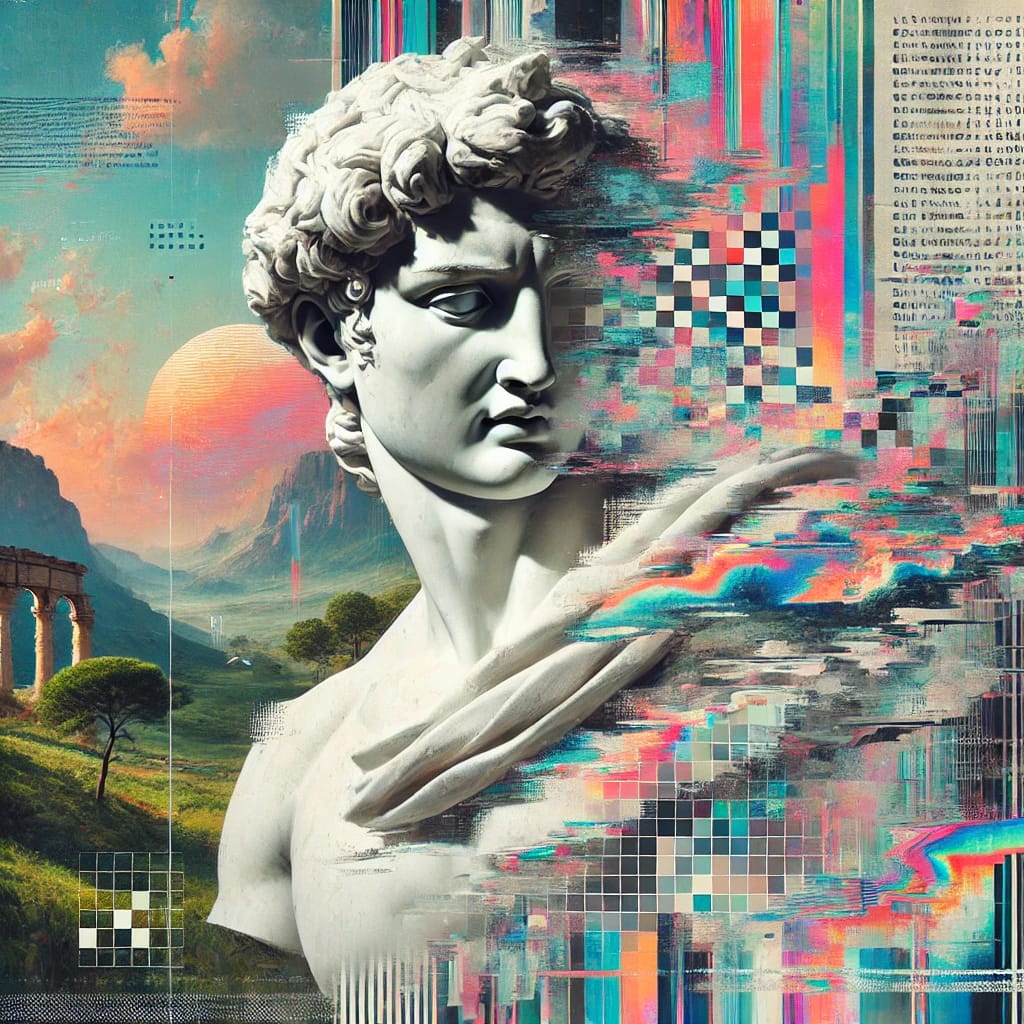
The sculptural face, caught between stability and digital distortion, becomes the metaphor for a consciousness seeking meaning in a world of continuous disintegration.
Complete details about the artwork
In 'The Eternal in Error,' the canonical form of classical beauty is subjected to controlled disassembly. The sculpture, once a symbol of order, reason, and harmony, is traversed by flows of visual rupture, chromatic errors, and digital interference. Thus, the image becomes a field of tension between two worlds: one of mythical stability and another of contemporary instability.
Fragmentation does not destroy, it reveals. Error is not just a technical flaw, but an existential principle. The face does not disintegrate gratuitously, but is 'rewritten' by the chaos of the present time. In this fissure between what was considered eternal and what is inevitably unstable, the fracturist meaning of the work is born.
Color — between cold turquoise, electric pink, and mineral grey — functions as a pulsation between life, memory, and the artificial. The natural and architectural background evokes a world still recognizable, but already contaminated by distortion, suggesting that no space remains intact in the face of error.
'The Eternal in Error' is not a mere representation of degradation, but a meditation on identity in the age of fragmentation. It is the portrait of a humanity that, while leaning on the forms of the past, is condemned to continually reconfigure itself through fissure, through defect, through instability.