„The Digit That Dreams of Being Human”
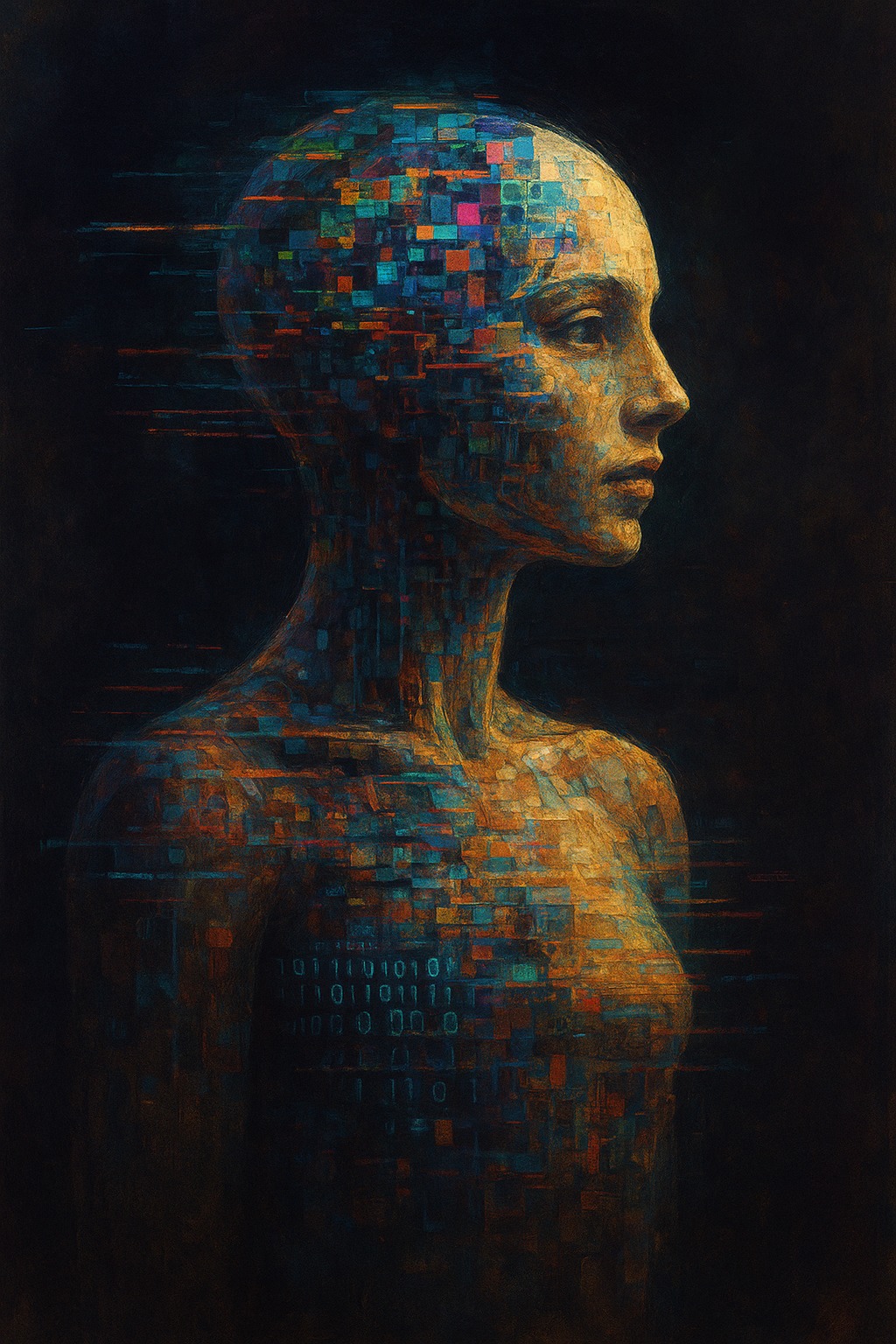
„The Digit That Dreams of Being Human” presents a digitized humanoid figure on the border between artificial and human, trying to overcome its algorithmic nature. Glitched forms and code fragments intertwine with attempts at organicity, and the cold color scheme, traversed by neon accents, emphasizes this transformation. The meditative gaze suggests the desire for identity, turning the work into a metaphor for the age where even humans are continuously reconstructed from fragmented data, images, and memory.
Complete details about the artwork
„The Digit That Dreams of Being Human” explores the fundamental tension between artificial and human, between code and consciousness. The humanoid figure, composed of digital fragments, dispersed pixels, random patterns, and binary code lines, seems to gradually detach from its own mathematical nature to seek a beginning of organic identity.
The composition uses a palette dominated by deep blue, muted gold, and neon accents, suggesting the transfer between two worlds. The upper part of the portrait, unstable and fragmented by glitches, appears to be in the midst of a rewriting process; the lower part tries to gain volume, texture, a simulated 'flesh.' This visual duality reveals the effort of a digital construct to become something more than looping algorithms.
The calm, meditative side-gaze conveys a desire for self-transcendence: a digit that aspires to be human. Every pictorial, digital, and fractured layer represents a stage in the search for synchronization between the mechanical and the organic, the virtual and the real, identity and projection.
The work becomes a metaphor for the contemporary world — a time when we, too, are constantly reconstructed from information, data, images, and fragments of our own memory.